
Standard downstream Methanol Synthesis or Fischer-Tropsch (FT) Unit is starved for hydrogen, people are leaving carbon efficiency and revenue on the table. Standard gasification or steam reforming often yields a lean syngas with an H2/CO ratio below 1.0. To unlock maximum throughput, we need a precise, reliable, and thermally optimized shift to reach the sweet spot: an H2/CO ratio of exactly ~2.1.
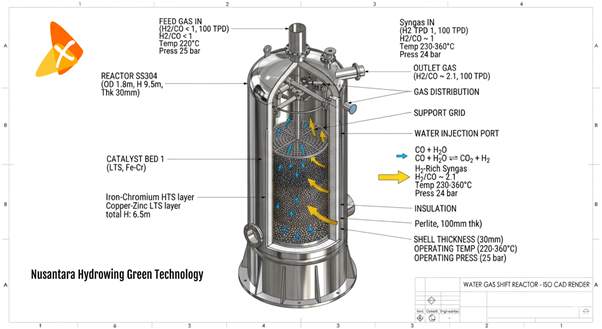
Our industrial-grade Water-Gas Shift (WGS) Reactor System is engineered specifically to bridge this gap, converting your low-ratio feed into a highly tuned, synthesis-ready stream.
The Core Technology: How It Works
The system leverages the exothermic Water-Gas Shift reaction to convert carbon monoxide and steam into additional hydrogen and carbon dioxide: CO + H2O —> H2 + CO2.
By strategically introducing a controlled bypass loop and advanced inter-stage cooling, our reactor design allows us to modulate the equilibrium precisely. We can shift exactly enough CO to hit the 2.1 ratio without over-shifting into costly hydrogen waste or excessive CO2 generation.
Catalyst Resilience: Optimized for sour or sweet syngas applications. Our sulfur-tolerant (sour shift) catalysts resist poisoning from trace contaminants, ensuring uninterrupted run-lengths exceeding 3 to 5 years.
Maximum Carbon Utilization: By avoiding over-shifting, we minimize the load on our downstream Acid Gas Removal (AGR) unit, reducing carbon capture operating costs.
For Methanol: It satisfies the precise stoichiometric module M = (H2 – CO2)/(CO + CO2) ~ 2.0 to 2.1, eliminating bypassed carbon.
For Hydrocarbon Through Fischer-Tropsch Synthesis: It provides the exact stoichiometric balance required for cobalt- or iron-based catalysts to maximize paraffinic/olefinic yields while minimizing methane byproduct formation.
Leave a Reply