
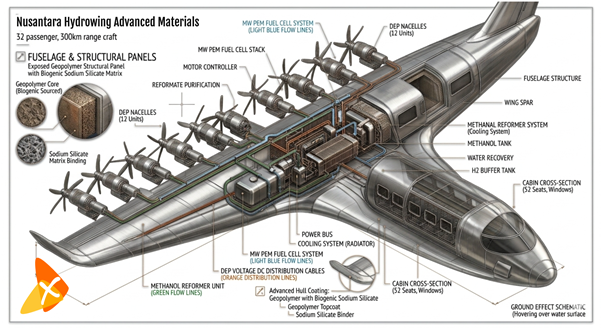
Wing-in-Ground-Effect (WIGE) aviation demands absolute optimization: maximum structural stiffness, minimal empty weight, and ruthless resistance to wave-slamming and marine corrosion. As we scale production of our next-generation WIGE crafts, traditional aluminum alloys and carbon-intensive composites force an unacceptable compromise between high manufacturing costs, extreme carbon footprints, and severe salt-water degradation.
Our Advanced Bio-Geopolymer Composite Matrix shatters these limitations. By replacing conventional carbon composites with a high-performance inorganic aluminosilicate matrix—synthesized using 100% circular, biogenic sodium silicate derived from agricultural silica waste—we deliver an aerospace-grade material engineered specifically for littoral and marine flight.
Here is why this system belongs in our WIGE design pipeline:
Ultra-Durable Marine Survivability: Unlike traditional aluminum which suffers from severe galvanic corrosion, or standard polymers that degrade under intense UV and salt exposure, our geopolymer forms an inert, rock-like barrier. It is completely immune to marine weathering and chloride attack, radically reducing your fleet’s lifetime maintenance cycles.
High Strength-to-Weight for Lower Take-Off Speeds: By reinforcing this green matrix with lightweight, high-tensile fibers, we achieve an exceptional strength-to-weight ratio. This directly reduces empty weight, lowering the critical speed required to catch the ground-effect cushion and maximizing your operational payload.
Ruthless Hydrodynamic Efficiency: When applied to our hull and hydrofoil configurations, the biogenic silicate creates an ultra-smooth, naturally hydrophobic, and highly amorphous surface network. This minimizes skin-friction drag during the high-resistance take-off phase, saving critical fuel and battery life.
Absolute Thermal and Fire Safety: WIGE vehicles operate in demanding boundary layers. Our geopolymer matrix is inherently non-combustible and withstands temperatures exceeding 1000°C without losing structural integrity or releasing toxic fumes—providing unparalleled safety for engine bays and passenger cabins.
True Zero-Carbon Innovation: Consumers and regulators are demanding green supply chains. By using a biogenic activator rather than energy-intensive commercial silicates, our material boasts an up to 80% lower carbon footprint than Portland-cement based structures and significantly outpaces traditional composites in sustainability metrics.
We aren’t just innovating a material; we are providing the structural foundation for the future of maritime transit. We would love to share our materials fo other application, just love to share good thing for this planet!
Leave a Reply