
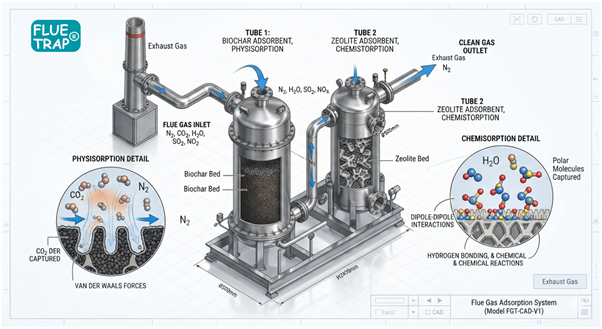
Meeting strict environmental mandates while controlling soaring operational expenditures. Standard single-stage scrubbers require massive energy and costly chemical treatments. Our Dual-Tube Flue Gas Trap solves this with a revolutionary two-stage separation process. It isolates and neutralizes emissions at the molecular level with near-zero energy input.
Stage 1: High-Volume Carbon Capture
Target: Non-polar molecules like CO2.
Sorbent: Low-cost, sustainably sourced biochar.
Mechanism: Physisorption via Van der Waals forces.
Benefit: Traps massive carbon volumes rapidly.
Stage 2: Acid Gas & Moisture Elimination
Target: Polar molecules like H2O, SO2, and NOx.
Sorbent: Highly porous, engineered synthetic zeolites.
Mechanism: Chemisorption and strong dipole-dipole bonds.
Benefit: Locks away highly toxic corrosive compounds permanently.
Combination of the above we can drastically lowers compliance penalties, reduces downstream equipment corrosion, cuts media replacement costs and integrates seamlessly with existing stacks. All of these with zero mechanical moving parts, it means no energy involve.
Traditional carbon capture systems—like amine scrubbing—are notoriously expensive because they require massive amounts of energy (often taking up to 30% of a plant’s total power output) just to heat and regenerate the liquid solvents. Because Stage 1 uses biochar physisorption via Van der Waals forces, it captures CO2 dynamically with virtually zero parasitic energy load, dropping your cost per ton dramatically.
Traditional carbon capture systems eat up to 30% of your plant’s power output just to run the chemical recovery loop. That means you are burning fuel just to clean the fuel you burned. Our system slashes your cost per ton of captured CO2 by over 50%.
By utilizing passive Van der Waals forces in the biochar stage, we eliminate the need for heavy thermal regeneration. Furthermore, instead of producing hazardous liquid waste that costs money to dispose of, your spent biochar turns into a stable, carbon-rich byproduct that can be sold directly to agricultural or construction markets. You aren’t just avoiding carbon taxes and regulatory penalties—you are creating a new, secondary revenue stream.
Leave a Reply