
The flying taxi era is here. But the multi-billion-dollar urban air mobility (UAM) market faces a fatal bottleneck: net-zero compliance. Regulators and cities will not allow thousands of electric aircraft to fly if their batteries, airframes, and vertiports carry a massive, hidden carbon footprint.
The Solution: We are pioneering the future of sustainable aviation by integrating biogenic sodium silicate into the core eVTOL supply chain. Unlike traditional sodium silicate, which relies on energy-intensive quartz sand mining and high-temperature furnaces, our material is sourced sustainably from agricultural waste (rice husk ash). We transform an environmental liability into a carbon-negative, aerospace-grade material that solves the three greatest engineering challenges of the eVTOL industry.
1. Battery Safety & Thermal Runaway Mitigation
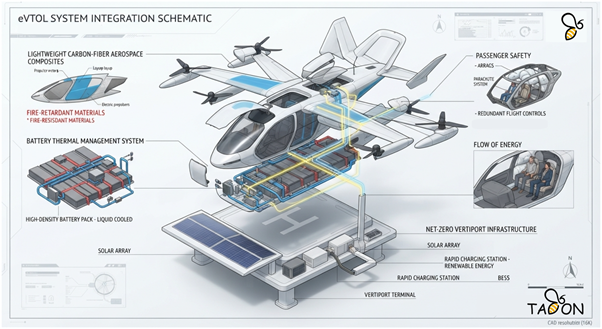
eVTOL vehicles demand high-output, energy-dense lithium-ion battery packs. The ultimate engineering risk is thermal runaway.
Ultra-Lightweight Insulation: We utilize biogenic sodium silicate to produce next-generation silica aerogels. These are the lightest solid materials known to science, offering unparalleled thermal insulation.
Range Optimization: Placed between battery cells, our aerogels create an impenetrable thermal barrier that prevents catastrophic fire propagation. Because they are ultra-lightweight, they maximize passenger safety without compromising flight range.
2. High-Performance, Fire-Retardant Composites
Aviation demands materials that are strong, ultra-light, and inherently fireproof.
Zero-Toxic Fireproofing: Our biogenic silicates serve as eco-friendly binders and coatings for advanced aircraft composites. Under extreme heat, they form a protective, glass-like barrier that blocks flames.
Eliminating Halogens: We replace heavy, toxic synthetic chemical retardants with a bio-sourced alternative that enhances structural integrity and provides exceptional corrosion protection against environmental wear.
3. Decarbonizing Vertiport Infrastructure
A truly net-zero UAM ecosystem requires green infrastructure. Building the vertiports of tomorrow with traditional Portland cement emits unmodeled gigatons of CO2.
Geopolymer Green Concrete: Our biogenic sodium silicate acts as the critical alkaline activator needed to manufacture geopolymer concrete.
80% Carbon Reduction: By blending our silicate with industrial byproducts, we enable operators to construct vertiport pads with an 80% lower carbon footprint than standard concrete, securing immediate regulatory approval.
We sit at the intersection of a soaring aerospace market and the mandatory global shift toward circular economies. By securing a proprietary, low-cost agricultural supply chain, we deliver aviation-grade safety, weight reduction, and infrastructure materials at a fraction of the carbon cost.
Leave a Reply