
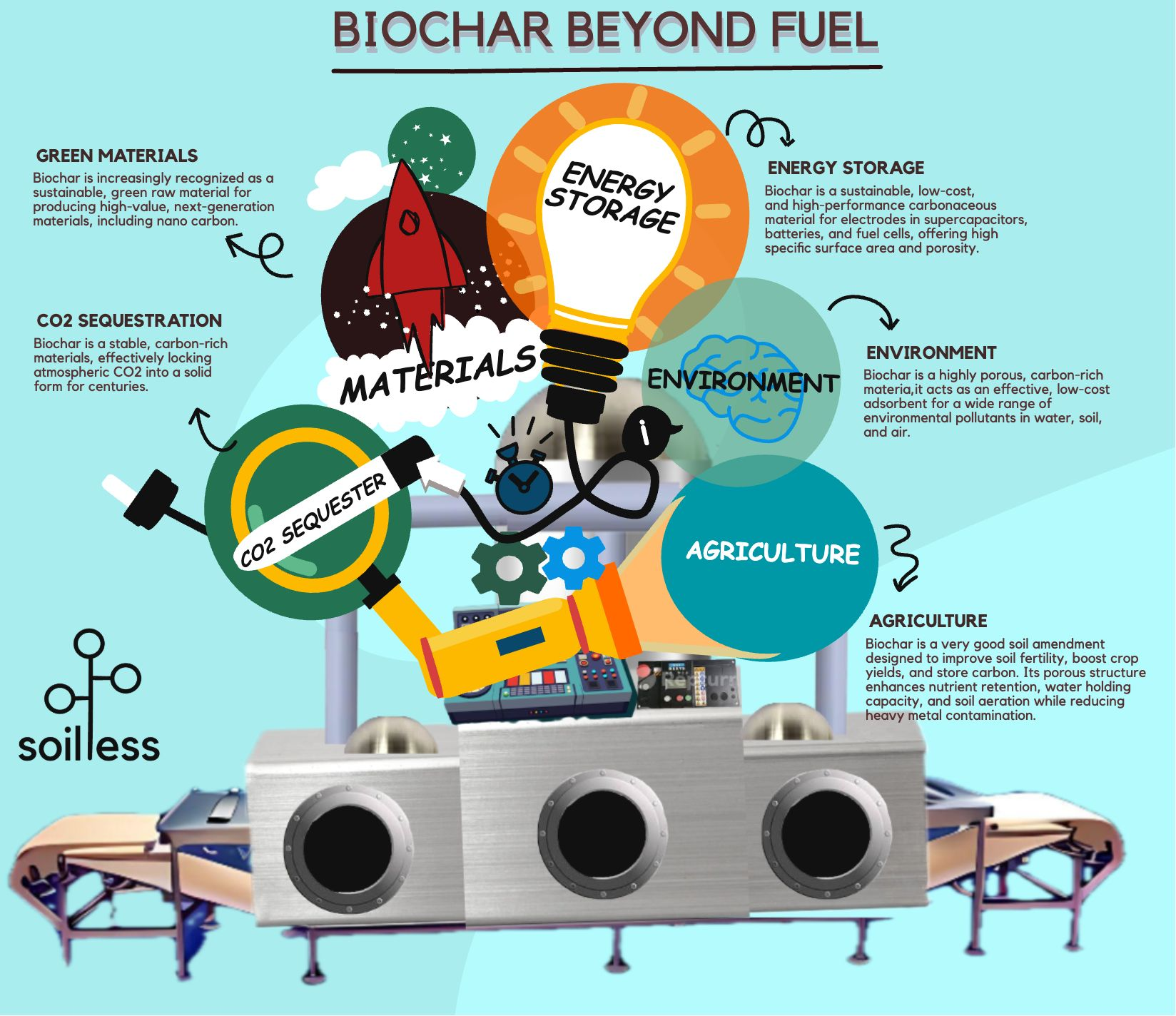
Biochar is a highly versatile carbon-rich material created through the pyrolysis of organic waste, with applications extending far beyond its use as a solid fuel. Its unique properties—high porosity, large surface area, and chemical stability—enable its use in environmental remediation, agriculture, and materials science.
Due to its high absorption capacity, biochar is effective at removing heavy metals, pesticides, and organic pollutants from water and soil. Used as a low-cost, sustainable filtration medium in water treatment and for treating stormwater runoff. Functions as an odor control additive and filter for capturing greenhouse gases and contaminants.
Enhances soil fertility by increasing water-holding capacity, nutrient retention, and beneficial microbial activity. Improves cation exchange capacity (CEC), allowing for reduced use of chemical fertilizers. Added to animal feed to improve digestive health, boost nutrient intake efficiency, and reduce odor-causing ammonia and methane emissions.
Used as a reinforcement in plastics, epoxies, and cement, improving durability and reducing the carbon footprint of building materials. Acts as a lightweight, porous component in green infrastructure, such as concrete, bricks, and insulation.
Used in electrodes for supercapacitors and Lithium-ion batteries as an anode material due to its electrical conductivity. Serves as a sustainable catalyst or support material for industrial chemical reactions, including CO2 conversion into value-added products.
When applied to soils, biochar locks carbon into a stable, long-lasting form, acting as a “black gold” carbon removal tool. Converts agricultural waste (rice husks, sugarcane bagasse) into a value-added product, supporting circular economy principles.
Biochar’s effectiveness varies based on the feedstock and production method, with high-temperature biochars (>600°C) typically showing greater aromaticity, stability, and suitability for industrial, non-soil applications.
Biochar for these various needs can also be produced using microwave-assisted carbonization (MAC), just as it is for fuel. MAC is by far the fastest, most energy-efficient, and smoke-free process.
Leave a Reply