
- Advanced WGS Technology
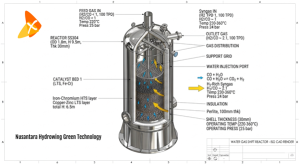 Standard downstream Methanol Synthesis or Fischer-Tropsch (FT) Unit is starved for hydrogen, people are leaving carbon efficiency and revenue on the table. Standard gasification or steam reforming often yields a lean syngas with an H2/CO ratio below 1.0. To unlock maximum throughput, we need a precise, reliable, and thermally optimized shift to reach the sweet spot: an H2/CO ratio of exactly ~2.1. Our industrial-grade Water-Gas Shift (WGS) Reactor System is engineered specifically to bridge this gap, converting your low-ratio feed into a highly tuned, synthesis-ready… Read more: Advanced WGS Technology
 - Biochar Beyond Fuel
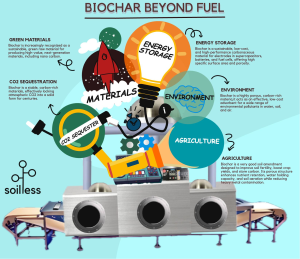 Biochar is a highly versatile carbon-rich material created through the pyrolysis of organic waste, with applications extending far beyond its use as a solid fuel. Its unique properties—high porosity, large surface area, and chemical stability—enable its use in environmental remediation, agriculture, and materials science. Due to its high absorption capacity, biochar is effective at removing heavy metals, pesticides, and organic pollutants from water and soil. Used as a low-cost, sustainable filtration medium in water treatment and for treating stormwater runoff. Functions as an odor control… Read more: Biochar Beyond Fuel
 - 7 Stages of Biomass Energy Development
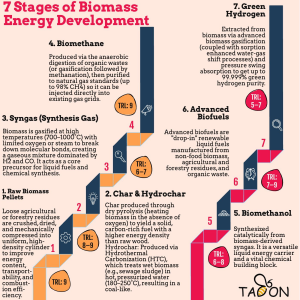 As a tropical and agricultural country, our country is rich in biomass resources, with plants growing all year round without a break. We should be the first country to break free from dependence on imported fossil fuels—a situation now disrupted by war. The following is 7 stages development of biomass-based biofuels, you can start at any stage, Climate Teach team ready to assist with appropriate technology solution for it. 1. Raw Biomass Pellets Loose agricultural or forestry residues are crushed, dried, and mechanically compressed into… Read more: 7 Stages of Biomass Energy Development
 - GREEN Hidrogen In SITU
 This production method yields highly competitive “green” (or “renewable”) hydrogen. By integrating gasification, Sorption-Enhanced Water Gas Shift (SEWGS), and Pressure Swing Adsorption (PSA), we can achieve high purity at the site. Producing and using it locally lowers costs by removing the need for expensive cooling, compression, and trucking. The Technology Breakdown Char Gasification: Heats solid carbon (char) with steam to create a mix of hydrogen and carbon monoxide (syngas). SEWGS: A clever one-step process. It uses solid materials to trap carbon dioxide inside the reactor… Read more: GREEN Hidrogen In SITU